How accurate is the New Testament text in our Bibles today?
Are the New Testament writings just man-made copies of copies handed down over hundreds of generations? How can we trust documents originally written over 2,000 years ago?
The “telephone game” is an example sometimes mentioned as a reason why the Bible can’t be trusted. The argument goes something like this:
“How could the Bible be trusted? Human beings are prone to mistakes; look at the telephone game. Even with the best efforts people can’t even get a sentence correct. How could human beings keep the Bible accurate over thousands of years?!”
Or
“How many times did the Bible get copied from one copy to another? After thousands of years, you’re looking at copies of copies of copies, etc.”
These are compelling arguments on the surface. However, they don’t fit the facts of history.
Rather, the evidence shows that the current Biblical New Testament is accurate to the original writings, because:
- Over 5,000 manuscripts have been found all throughout the ancient world, with no significant differences between them.
- Some of these documents date back to as early as 100 to 300 AD, with many thereafter, proving they had to be written, copied, and spread across thousands of miles within 1-2 generations.
- What we see in our current Bibles are translations of the early manuscripts and aren’t copies of copies at all. Rather, they are faithful translations of ancient manuscripts very close to the original writings (translations because the originals were written in Greek).
Whether you’re a skeptic or believer, let’s explore in a little further detail how the New Testament in our modern Bibles came to be.
Tracing the date and locations of the ancient manuscripts
Biblical manuscripts have been found all over the ancient world. Although, the majority come from cities which contained both a focus for scribal work and large, carefully catalogued libraries.
During the first century AD, this takes us to Rome, Alexandria (Egypt), and Constantinople (now Istanbul, Turkey).
Constantinople is where the majority of New Testament Biblical manuscripts have been found, some dating back to the fourth and fifth centuries (300-400 AD). Additionally, many were found at Rome and Alexandria dating back to the second and third centuries (100-200 AD).
It makes sense that a rapidly growing religious movement would lead to manuscript evidence being plentiful in and around such cities, where critical documents would have been created, copied, stored, and shared.
See the map below for additional geographical context:
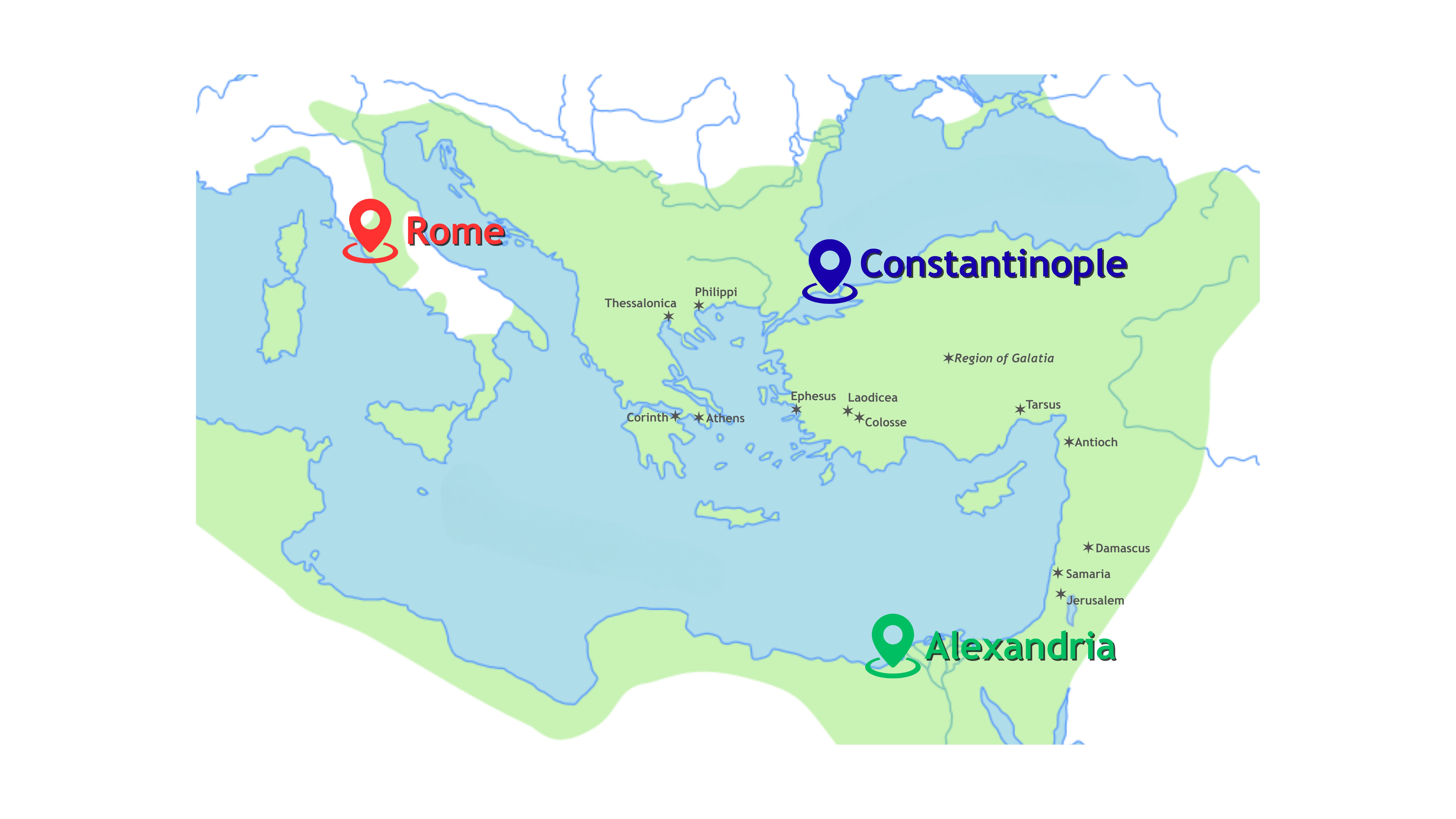
Throughout history, archeologists and scholars have collected well over 5,000 unique manuscripts of the New Testament, mainly from these three regions.
These manuscripts range in size from tiny fragments the size of a child’s hand to full copies of the entire New Testament.
Between the first and seventh centuries, documents were primarily written on papyrus (sheets made by pressing and drying the pith of the papyrus plant).
Papyrus manuscripts were extremely fragile over long periods of time, however. This is why most of what we have of them today are brittle fragments of what they once were. Moreover, dry and arid climates like that in Egypt tended to preserve them the best.
While there were actually a large amount of small differences between these manuscripts (some estimates put the total at 400,000 - 500,000 in total), the vast majority are spelling and punctuation (90% or more) and even the substantive differences do not disagree on any key Christian theological issues.
How did this information eventually make it into our current Bibles?
An emerging challenge for early New Testament scholars and church leaders centered on which information to prioritize and how to organize everything. Since many of these manuscripts would continue to be found over the next 2,000 years, this was an ongoing challenge.
History shows their answer was to combine texts into volumes called codices, which incorporated different sources and unified the existing manuscripts of their day.
Now the codex (plural, codices) isn’t strictly a Christian term. It was invented by the Romans and essentially was the invention of the modern book, as it consisted of pages bound together along one side. The pages of a codex could be made of papyrus, vellum, or parchment (the latter two being made of animal skin). Parchment would take over as the primary writing material of codices at some point between the 2nd and 4th centuries.
Therefore, the ancient Biblical texts include papyrus manuscripts found mostly in Alexandria and Rome starting in 100-300 AD and codices made of parchment/vellum, the majority found in Constantinople between 400-1500 AD. Although, very important codices were also found in Alexandria and Rome, as well. More on that later.
One of the most important codices, for example, is the “Textus Receptus”, created in the 1500s. While Martin Luther was taking on the Catholic Church, a reformer named Erasmus created his own Greek New Testament codex combining all the information available at his time. This later evolved into the “Textus Receptus” (i.e. Received Text, in Greek) as future scholars continued to add to and improve on Erasmus’s work. The Textus Receptus was the source William Tyndale used to translate the first ever English translation around 1530. Also, the Authorized King James Version, created in 1611, was translated from this updated Textus Receptus.
Looking at the important manuscripts and codices from each geographical area
The “Byzantine Texts”, from Constantinople
- Earliest Manuscripts: 400-500 AD.
- Also called the “Majority Text” because roughly 90% of the 5,000 manuscripts come from this area.
- Many of the codices created between 1000-1500 AD.
- Little to no papyrus fragments in this group (climate was not dry enough).
- Constantinople became capital of Eastern Empire in 4th century, which likely played part of the historical record.
- Erasmus (Protestant Reformer during time of Martin Luther) created full Greek New Testament using the Majority Text in 1500s.
- Textus Receptus (aka “the Received Text”) - Erasmus’s Greek NT was renamed to this in 1633 as new manuscripts were found and incorporated by other scholars. This Greek NT became the gold-standard for study and translation into other languages between the 1500s-1800s (outside of the Catholic Church).
- William Tyndale translated the first English translation in 1530s using the Textus Receptus.
- KJV created in 1611 using the Textus Receptus, based on the Majority Text.
- Some believe the KJV is the only proper English translation to this day due to belief that other manuscript sources have been compromised by the Catholic Church.
The “Alexandrian Texts”, from Alexandria, Egypt
- Earliest Manuscripts: 150-300 AD.
- Many papyrus fragments dating back to 150-300 AD, likely preserved by the dry climate.
- Codex Sinaiticus: 330-360 AD
- Contains complete NT and most of OT, making it one of if not the oldest full NT manuscripts.
- Found in a monastery on the Sinai Peninsula in Egypt.
- Codex Vaticanus: 300-325 AD
- Contains most of NT and OT.
- Very closely matches Codex Sinaiticus, making these two among most important and earliest NT codices, these also show the unity of the early NT manuscripts.
- Codex Alexandrinus: 400 AD
- Contains both Alexandrian and Byzantine texts, making this technically a mixed text.
- Some historians conclude these texts and codices are more accurate to original writings for two reasons:
-
- The Bible verses tend to be less wordy than the Majority Text, and history shows scribes tend to add words over time in attempts to clarify what may appear to be confusing.
-
- The manuscripts date earlier.
-
- Starting in 1800s-1900s, English translations began to incorporate more of the Alexandrian Texts in their sources to incorporate earlier and more expansive sources.
- Nestle-Aland Greek New Testament (and similarly, the Westcott-Hort NT before it):
- Currently on 29th edition as scholars continue to update and modify it with new discoveries/advances.
- Considered by many, if not most, scholars to be the most accurate Greek NT to the originals.
- Most current translations incorporate Alexandrian texts (and all manuscript evidence), such as the NIV, ESV, NASB, NLT, and others.
The “Western Texts”, from Rome
- Earliest Manuscripts: 150-300 AD
- Lots of papyrus fragments, some dating back to 150 AD, or earlier (such as p104, containing Matthew 21, 43, 45).
- Codex Bezae: 400 AD:
- Contains all 4 Gospels and Acts.
- Codex Claromontanus: 550 AD:
- Contains Pauline Epistles.
- Catholic Church at Rome preferred translations into Latin. Therefore, we see several codices appearing in Latin such as Jerome’s Latin Vulgate (written in 300s AD).
- Vetus Latina (predated Vulgate) - 200 AD.
- Codex Sangallensis - 400 AD.
- Codex Fuldensis - 500 AD.
- Codex Amiantinus - 700 AD.
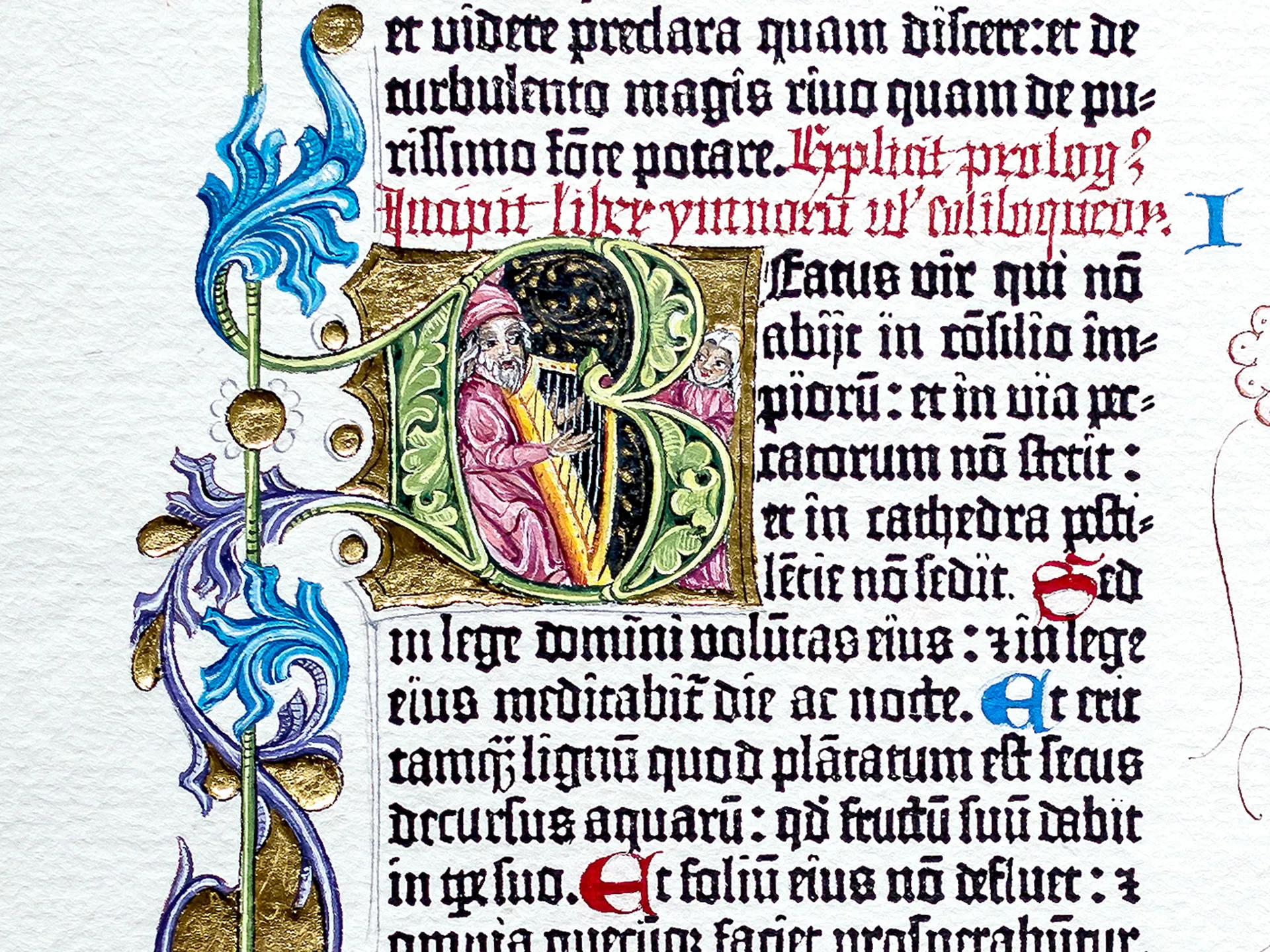
- Gutenberg Bible - 1400, was the first book ever printed using a printing press (with moving metal parts) and was printed in Latin.
- Earliest English translations were based on the Latin Vulgate:
- Lindisfarne Gospels - 700 AD.
- John Wycliffe Bible - 1300.
- Douay-Rheims Bible - 1600.
- Revised in 1752.
- Remained main English Bible in Catholic circles until 1970s.
- Nova Vulgata - 1979
- Current Latin Bible used by Catholics today.
Translations
Before we wrap up, let’s briefly touch on the various Biblical translations.
Anyone who’s attempted to read the Bible will note there are sections which are more difficult to read than others.
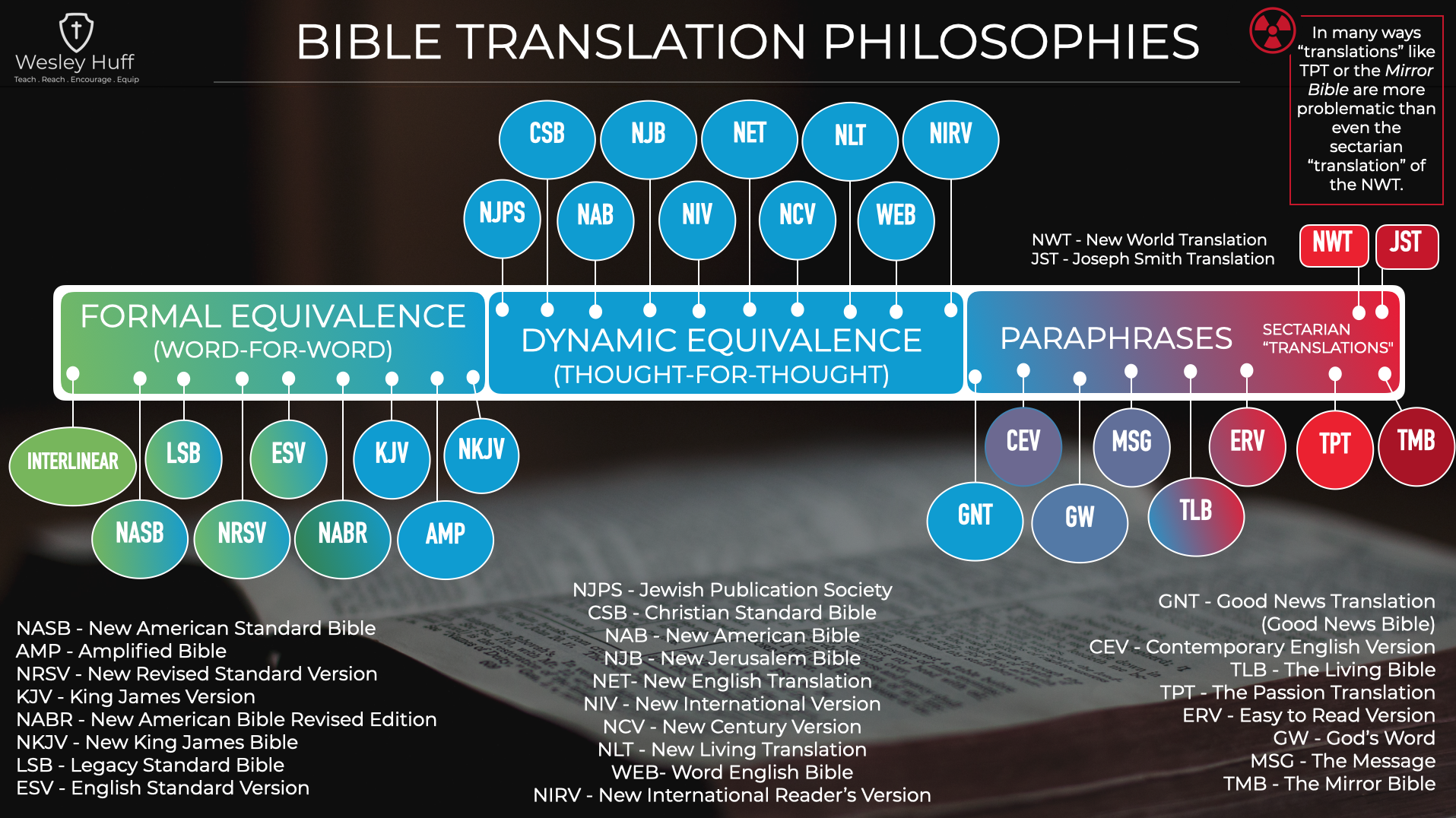
In an effort to reach more people with the Bible, dozens of different Bible translations have been created. Some translations try to mirror the exact word-by-word structure of the original Greek. On the other side of the spectrum, other translations aim for easier readability by paraphrasing concepts and ideas, as Greek and English don’t often align perfectly. Others in the middle try to balance an exact word-for-word style with easier readability.
Christian apologist, Wesley Huff, created this helpful infographic illustrating current popular Bible translations and his interpretation of where they land on that spectrum.
It’s designed to be read from left to right, where the far left represents exact word-for-word translations and far right represents paraphrased translations (and those in the middle). Where a translation lands on this spectrum illustrates how it compares to others, i.e. the ESV translation is slightly less exact and more readable than the NASB even though they are both in the “word-for-word” section.
In Conclusion
As I studied to write this, I couldn’t help but be amazed by the incredible care and preservation of the Bible over these past millennia. Perhaps you might even agree with me in saying that there appears to be a Divine Hand guiding the process behind the scenes.
Regardless, the evidence demonstrates that the New Testament Biblical text originates from:
- An overwhelming wealth of textual evidence with 5,000+ manuscripts across thousands of years, showing no significant differences between them.
- Manuscript evidence dating back to as early as 100 to 300 AD or earlier, giving these numerous documents almost no time to be altered from the originals.
- Translations from the earliest documents in existence, and represent the closest texts to the originals, perhaps more so than any other text in history. And, they aren’t copies of copies of copies.
I hope this article has helped to shed light on the origins of the Biblical New Testament texts and, if you have questions or comments, please know those are VERY welcome! Please use the comments below.
If you’ve made it this far, thank you for the gracious gift of your time. It is genuinely appreciated.
Love you all!
Notes:
- You may have noticed, I didn’t touch on the Bible’s Old Testament or HOW the New Testament books were “selected”. I hope to address both in future articles.
- Resources:
- How We Got the Bible, by Greg Lanier
- UsefulChart YouTube video
- Cross Bible Digital Timeline
- Wesley Huff (Various Resources)